
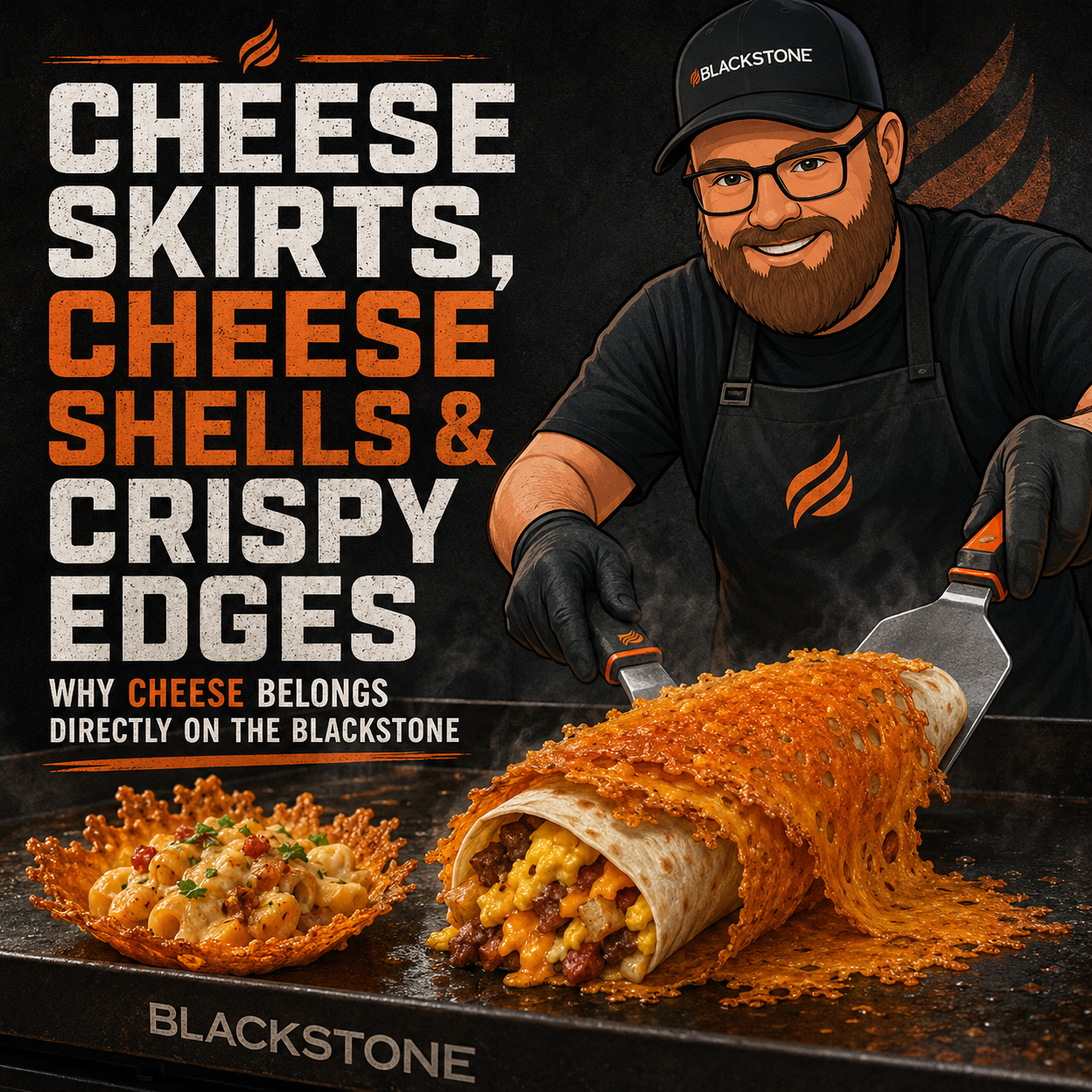

One of my favorite things about cooking on a Blackstone is discovering that an ingredient can do more than what I normally expect from it. Cheese is a perfect example. Most of the time, we think of cheese as something that goes on a burger, inside a sandwich, or over a pile of food so it can melt. On a griddle, though, cheese can become an ingredient with structure all its own.
Put shredded cheese directly onto a hot Blackstone and leave it alone for a little while, and something pretty great starts happening. The cheese melts, the moisture cooks away, and the bottom begins to brown and crisp against the steel. Give it enough time and you end up with something that can be folded, wrapped, or used almost like a shell.
I have started using that technique in several different ways, and it has become one of those little griddle tricks that can completely change an otherwise familiar recipe.
The Cheese-Skirt Breakfast Burrito
A breakfast burrito is already a pretty perfect Blackstone food. You can cook the bacon, scramble the eggs, warm the tortilla, and sauté any vegetables all on the same surface.
For one version, I filled a tortilla with bacon, scrambled eggs, avocado, tomato, and the usual breakfast-burrito goodness. I could have stopped there and had a perfectly good burrito.
Instead, I sprinkled shredded cheese directly onto the griddle in a thin layer and let it melt until the bottom became golden and crisp. Once the cheese had enough structure, I rolled the finished burrito across it, allowing that crispy cheese to wrap around the outside.
Now the burrito had a completely different texture. You still had the soft tortilla and hot filling, but the outside had this salty, crispy cheese layer around it.
It was a small extra step, but it became the most interesting part of the recipe.
Turning Cheese Into the Wrapper
I pushed the same idea even farther with a pasta dish.
I had cooked ziti with marinara and cheese, but instead of simply piling more mozzarella over the top, I created a large layer of cheese directly on the griddle. Once it melted together and began developing that browned bottom, I put the saucy pasta on top and folded the cheese around it.
The result was something like a baked-ziti burrito—except there was no tortilla.
The crispy cheese was the wrapper.
Was this something traditional Italian cooking had been desperately waiting for? Probably not. But it was fun, it tasted great, and it showed just how differently an ingredient can behave when it meets a flat-top griddle.
The Trick Is Knowing When the Cheese Is Ready
The hardest part of making a cheese skirt or shell is resisting the urge to touch it too quickly.
When cheese first melts, it is soft and oily. Try to move it at that stage and you will probably end up scraping melted cheese around the griddle instead of lifting a nice shell.
I let it continue cooking until the bottom develops color and the edges begin looking crisp. As moisture cooks out, the cheese becomes noticeably easier to lift with a spatula.
You are looking for the point where it has enough structure to move but is still flexible enough to wrap around whatever you are making.
Go too early and it falls apart.
Wait too long and you may end up with something closer to a cheese cracker.
Neither is necessarily bad, but they produce very different results.
Not Every Cheese Behaves the Same Way
For this technique, I usually want a cheese that melts well but also browns nicely.
Cheddar can work particularly well because it develops a lot of flavor as it crisps. Colby Jack and Monterey Jack are good options when I want something a little milder. Mozzarella can work too, particularly in something like the ziti, although it has more moisture and may need a little extra time before it develops structure.
Pre-shredded cheese will work, but freshly shredded cheese often melts more smoothly because it does not have as much anti-caking powder coating the shreds.
I am not overly rigid about it, though. Part of the fun is trying whatever cheese is already in the refrigerator and seeing what happens.
Heat Matters
Like most things on a Blackstone, hotter is not automatically better.
If the griddle is screaming hot, the cheese can scorch before it has time to melt evenly. I generally prefer a moderate cooking zone where the cheese has time to melt, spread, and then gradually crisp.
You also do not need additional oil underneath it. Cheese brings plenty of its own fat to the party.
Once it starts rendering, you will usually have more than enough lubrication between the cheese and the steel.
Cheese Skirts Aren’t Just for Burritos
Once you understand the basic technique, there are a lot of directions you can take it.
A crispy cheese edge around a smash burger is an obvious one. You can intentionally let cheese spill beyond the burger so the portion touching the griddle becomes crisp while the cheese over the meat stays melted.
You could build cheese shells for tacos, add a crispy cheese layer to a breakfast wrap, or use a small cheese crisp as a topping for another dish.
Even if you do not go as far as wrapping an entire meal in cheese, intentionally letting cheese contact the griddle can add a texture you cannot get by simply melting it on top.
That contrast is what makes the technique worthwhile.
It Also Makes Food More Fun
I do not think every Blackstone recipe needs a trick.
Sometimes a cheeseburger should just be a cheeseburger.
But one of the reasons I enjoy cooking on a griddle is that it makes experimenting easy. You have this large, hot surface right in front of you, and sometimes a simple idea like putting cheese directly onto it leads to something completely different.
A breakfast burrito becomes a cheese-crusted breakfast burrito.
A pan of ziti somehow becomes something you can pick up.
A little escaped cheese around the edge of a burger becomes the bite everybody wants.
That is the kind of experimentation I enjoy most because it is not complicated. It is simply taking advantage of what the Blackstone does particularly well.
Final Thoughts
The next time you are cooking with shredded cheese on your Blackstone, do not automatically assume it has to stay on top of the food.
Put some directly on the griddle.
Let it melt.
Leave it alone long enough to brown.
Then see what you can do with it.
Sometimes the best part of the recipe is the cheese that accidentally touches the griddle and gets crispy around the edges.
I just decided to start doing it on purpose.
Leave a Reply