
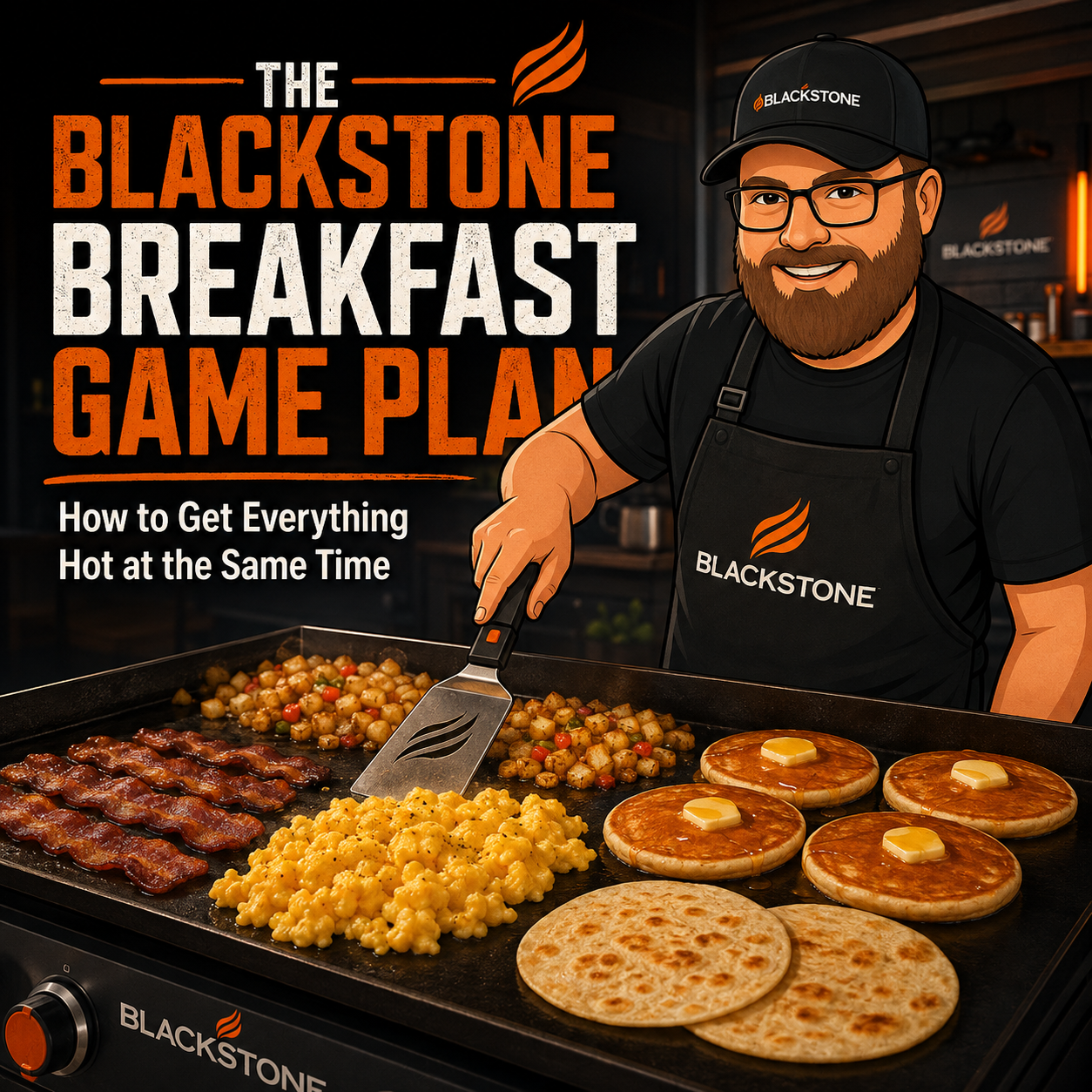

Breakfast is one of the best things to cook on a Blackstone, but it can also become chaotic fast. Bacon, sausage, hash browns, pancakes, eggs, tortillas, and toast all cook at different speeds. The trick is not cooking faster—it is knowing what needs to hit the griddle first and what can wait until the very end.
Breakfast was one of the things that originally made the Blackstone so appealing to me. You can cook an entire meal outside on one big surface instead of dirtying several pans inside. Bacon can cook beside hash browns, pancakes can go down while sausage finishes, and eggs can be made right before everything goes to the table.
That sounds simple until you actually try to do all of it at once.
If you start everything at the same time, something will almost certainly finish too early. Your eggs will be cold by the time the potatoes are done, the pancakes will be sitting around while the bacon catches up, or you will be frantically trying to toast tortillas while everybody else’s food is already ready.
Over time, I have learned that a good Blackstone breakfast is really a timing exercise. Once you have a basic order of operations, the entire cook becomes much easier.
Start With Whatever Takes the Longest
My first question is always: What is going to take the most time?
Most of the time, the answer is potatoes.
Hash browns, diced potatoes, or sweet potatoes usually need more time than almost anything else on the breakfast menu, so I get those going first. I want them cooking while I prepare the rest of the meal instead of discovering at the end that everyone is waiting ten more minutes for potatoes.
Bacon can also start fairly early because it benefits from a slower cook and does not suffer much if it finishes a few minutes before everything else. Sausage works similarly, although thinner patties or crumbled sausage will obviously cook faster than thick links.
The foods that take the longest should be doing their thing while you work on everything else.
Use the Griddle as Several Cooking Zones
One of the biggest mistakes people make with breakfast is treating the Blackstone like one giant burner.
I usually want several different temperatures happening at once.
The hotter area can handle potatoes or meat that needs browning. A medium section works well for pancakes or tortillas. A lower-temperature section can hold finished food without continuing to aggressively cook it.
That cooler section becomes especially useful as breakfast progresses. Bacon can move there once it is crisp. Sausage can sit there while eggs finish. Finished pancakes can stay warm without getting darker every thirty seconds.
You do not need every inch of the griddle blazing hot. In fact, breakfast is much easier when it is not.
Meat Comes Before Eggs
Bacon and sausage are forgiving.
Eggs are not.
That is why I almost always want the meat substantially finished before I even think about putting eggs on the griddle.
If I am making breakfast burritos or tacos, I might cook and crumble the sausage, then move it to a cooler area while I work on potatoes, peppers, onions, or whatever else is going into the filling. The meat stays warm, and I am not rushing the eggs because something else is still raw.
Bacon works the same way. Once it is crisp, I can move it out of the way and even use some of that bacon grease to cook another component of the breakfast.
By the time the eggs hit the griddle, I want most of the meal already under control.
Pancakes Belong Somewhere in the Middle
Pancakes cook quickly, but not quite as quickly as eggs, which makes them a good middle-of-the-cook item.
Once the longer components are well underway, I can dedicate a medium-temperature section of the griddle to pancakes. They cook, get flipped, and then move to a cooler area or warming rack while the rest of breakfast comes together.
The biggest thing I try to avoid is cooking pancakes over excessive heat. A pancake can look beautifully browned outside while still being undercooked in the middle. Medium heat gives the center enough time to cook before the exterior gets too dark.
It also makes the cook much less stressful because I am not racing to flip them every few seconds.
Eggs Go Last
If there is one breakfast rule I follow almost every time, it is this:
Eggs go last.
Scrambled eggs cook incredibly quickly on a hot Blackstone. Fried eggs do too. Once they are finished, the clock starts ticking because eggs are noticeably better hot and fresh.
By the time I start the eggs, the potatoes should be done or nearly done, the meat should be cooked, and the bread or tortillas should be ready to go.
I often lower the heat considerably before cooking eggs, and sometimes I will even turn a burner off and use the residual heat in that section of the griddle. The steel holds plenty of heat, and eggs do not need an aggressive temperature.
That makes it much easier to keep them soft instead of turning them into dry little pieces before they reach the plate.
Tortillas, Toast, and Buns Need a Plan Too
Bread products are easy to forget because they cook so quickly.
Then suddenly everything else is finished and you realize your breakfast tacos still need warm tortillas.
I try to fit tortillas or bread into the final few minutes before the eggs. Tortillas only need a short amount of time on the griddle to become warm and pliable. Bread can be lightly toasted while the last major component finishes.
For breakfast burritos, I warm the tortillas shortly before assembly so they stay flexible and do not crack when rolled. If I am making a crunch wrap, breakfast sandwich, or something that needs a final griddle toast after assembly, I account for that too.
The meal is not finished when the filling is cooked. It is finished when the whole thing is ready to serve.
Breakfast Burritos Are a Great Example
A loaded breakfast burrito is a perfect example of why the order matters.
If I am making one with bacon, eggs, potatoes, peppers, avocado, and tomato, I am not putting all of those ingredients on the griddle at once.
The potatoes start first. Bacon follows. Peppers or onions can cook while those are underway. Once the hot filling components are finished, they can move to a cooler zone.
Then I warm the tortilla.
Eggs go down near the very end.
Fresh ingredients like avocado and tomato never need to cook at all.
Then everything gets assembled while it is still hot.
If I am adding something extra like a crispy cheese skirt around the outside of the burrito, that happens after the burrito is built. The final griddle step becomes part of the timing plan instead of something I suddenly remember at the end.
Breakfast Tacos Work the Same Way
The same thinking applies to breakfast tacos.
For sausage and sweet potato breakfast tacos, for example, the sweet potatoes need a head start because they take longer than everything else. Sausage can cook beside them, followed by onions and peppers.
Once those components are ready, I can combine them and hold them briefly while I cook the scrambled eggs.
Warm tortillas and fresh salsa come at the end.
The result is that everything reaches the taco hot without overcooking the eggs or letting the potatoes hold up breakfast.
Prep Makes Breakfast Much Easier
Breakfast moves fast once the cooking begins, so I try to have most of the prep finished before anything hits the griddle.
Vegetables are chopped.
Eggs are cracked and ready.
Cheese is nearby.
Tortillas are out of the package.
Serving plates are where I can reach them.
There is nothing worse than putting eggs on a hot griddle and then realizing you still need to find the cheese, open the tortillas, and slice an avocado.
Those extra few minutes of preparation make the actual cook feel much more relaxed.
My Basic Order for a Big Blackstone Breakfast
I do not follow the exact same sequence every time, but my general breakfast rhythm usually looks something like this:
1. Potatoes or hash browns
They usually need the most time.
2. Bacon and sausage
Get the proteins cooked and move them to a cooler zone when finished.
3. Vegetables
Onions, peppers, mushrooms, or anything else that needs sautéing can cook while the meat and potatoes are underway.
4. Pancakes or other medium-speed items
Cook them once the slower foods are close.
5. Tortillas, toast, or buns
Warm or toast them shortly before assembly.
6. Eggs
Almost always last.
7. Fresh toppings and final assembly
Avocado, tomato, salsa, sour cream, green onions, and other fresh ingredients go on right before serving.
It is not a rigid formula, but it gives me a plan before the griddle gets crowded.
The Goal Is for Everything to Finish Together
A great Blackstone breakfast does not mean every ingredient starts cooking at the same time.
It means they finish at roughly the same time.
That is the important distinction.
Once I started thinking about breakfast that way, the cooks became much easier. I was no longer trying to manage eight foods simultaneously. I was managing a sequence.
Potatoes start.
Meat follows.
Vegetables join in.
Pancakes get their turn.
Bread gets warm.
Eggs finish the meal.
Then everybody eats.
Final Thoughts
Breakfast may be one of the best demonstrations of what a Blackstone can do because so many different foods can cook on the same surface. The key is resisting the temptation to throw everything down at once.
Start with the slow foods.
Use multiple heat zones.
Move finished ingredients somewhere cooler.
Save delicate foods for the end.
And almost always, cook the eggs last.
Once you get the timing down, a big Blackstone breakfast stops feeling like chaos and starts feeling like a system.
And when the bacon, potatoes, pancakes, eggs, and tortillas all reach the table hot at the same time, that little bit of planning is absolutely worth it.
Leave a Reply