
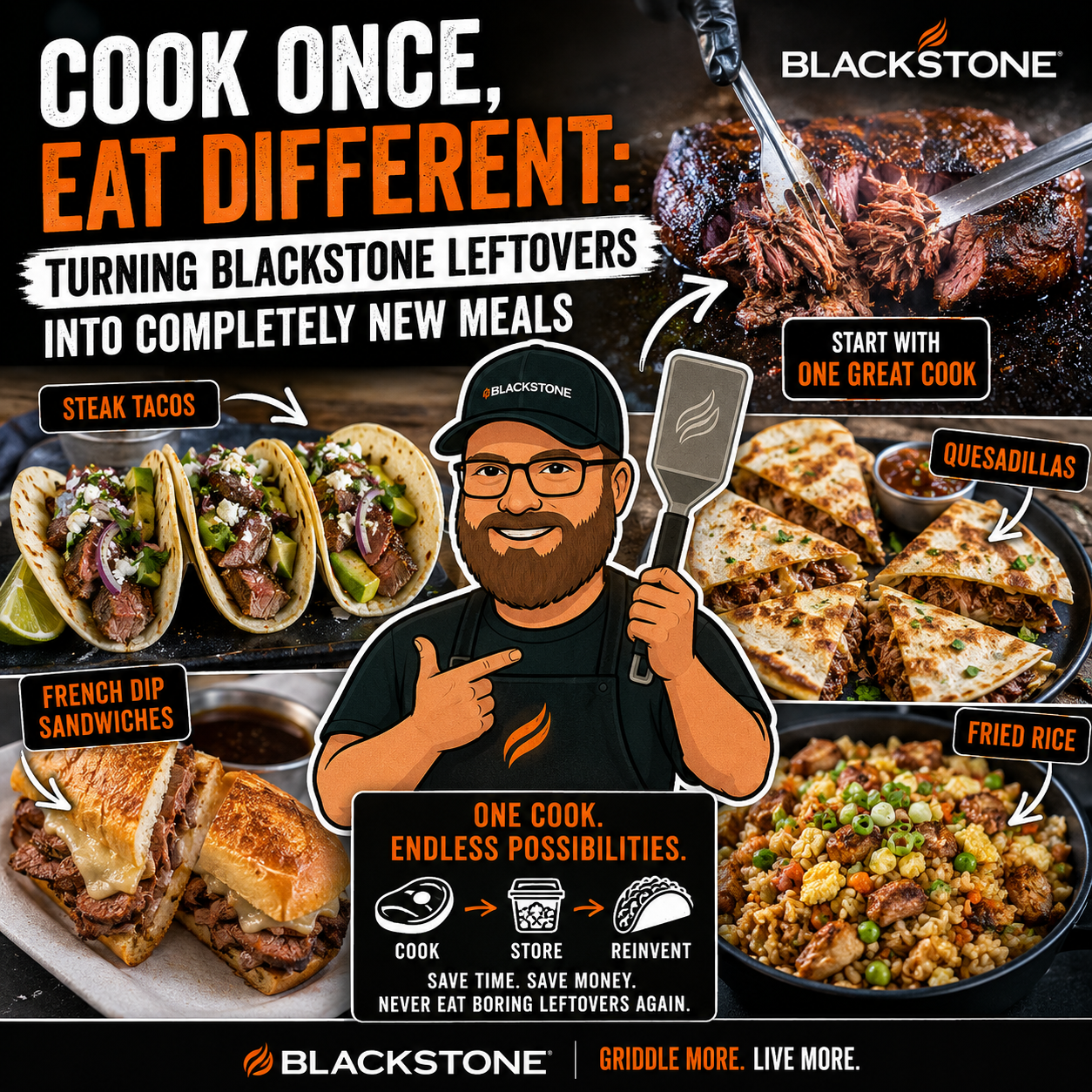

One of my favorite ways to get more out of a Blackstone cook is to stop thinking of leftovers as something that simply needs to be reheated. A good piece of smoked or griddled meat can become the starting point for an entirely different meal the next day.
There is a big difference between eating leftovers and cooking with leftovers.
Eating leftovers usually means putting yesterday’s dinner on a plate, reheating it, and having essentially the same meal again. There is absolutely nothing wrong with that, especially when the original meal was good, but it is not usually something anyone gets especially excited about.
Cooking with leftovers is different.
Instead of looking at that container of beef, pork, or chicken in the refrigerator and asking, “How should I warm this back up?” I try to ask, “What can I turn this into?”
That small change in thinking has led to some of my favorite second-day Blackstone meals.
A beef tenderloin that was the centerpiece of dinner one night can become steak tacos the next day and a French dip sandwich after that. A smoked chuck roast can become shredded beef sandwiches, tacos, or breakfast hash. Pulled pork can go from barbecue dinner to crispy tacos or quesadillas with only a few minutes on the griddle.
The leftovers stop feeling like leftovers because the meal itself is completely different.
Start by Cooking Something Worth Reusing
The easiest way to create good leftover meals is to start with a protein that can go in several directions.
A large chuck roast is a perfect example. When I cook one low and slow on the Blackstone pellet grill, I am usually making enough that I know there will be meat left over.
That is intentional.
The first night, maybe we eat the shredded beef with the onions and au jus it cooked in. Another day, that same beef can go onto the Blackstone griddle, develop a few crispy edges, and become tacos. It can also be piled onto toasted bread with melted cheese and served with the remaining au jus as a sandwich.
The meat has not changed.
The meal has.
That is why I often think about leftovers before the original cook is even finished.
If I am spending several hours smoking a large piece of meat, making enough for more than one meal gives me a much better return on that time.
Beef Tenderloin Is Too Good to Waste
A recent beef tenderloin cook is probably one of my favorite examples.
I reverse seared the tenderloin by cooking it low and slow on the Blackstone pellet grill before finishing it with a hard sear on the Blackstone griddle.
The first meal was exactly what you would expect: thick slices of tenderloin served as the star of the plate.
But we had some left.
I definitely was not going to take good beef tenderloin and simply microwave it until it turned gray.
Instead, we turned it into completely different meals.
Leftover Beef Tenderloin Becomes Steak Tacos
For the tacos, I sliced the leftover tenderloin and warmed it carefully on the Blackstone.
That word—carefully—matters.
The beef was already cooked exactly the way I wanted it. The goal was not to cook it again. I only needed to bring it back up to temperature without pushing it from medium-rare into well-done.
The griddle makes that easy because I can use a lower heat zone, warm the meat quickly, and get it off the steel as soon as it is ready.
Then we built tacos with warm tortillas, avocado, red onion, cheese, crema, and fresh lime.
At that point, nobody was sitting at the table thinking, “Here comes last night’s dinner again.”
It was taco night.
The tenderloin just happened to be the ingredient that made it possible.
Then the Same Beef Became French Dip Sandwiches
The tenderloin went in another direction after that.
This time, we made French dip sandwiches.
Thin slices of beef went onto toasted rolls with plenty of melted cheese, and the sandwiches were served with warm au jus for dipping.
Again, the Blackstone gave me several cooking zones to work with. I could gently warm the meat, toast the bread, and melt the cheese without exposing everything to the same amount of heat.
The resulting meal had almost nothing in common with the original tenderloin dinner other than the protein.
That is exactly what I want from leftovers.
If I am going to eat the same ingredient several times, I would much rather experience it in several different ways.
The Griddle Is Excellent at Bringing Leftovers Back to Life
One reason the Blackstone is so useful for leftover cooking is texture.
A microwave can make something hot.
A griddle can make it interesting again.
Pulled pork is a great example.
After spending hours in a smoker, pulled pork is tender and juicy. Refrigerate it overnight, though, and it naturally loses some of that just-cooked texture.
Put it on a hot griddle and something different happens.
Spread the pork out and let parts of it make direct contact with the steel. Some pieces stay tender while others develop crispy, caramelized edges.
Now the leftover pork has a texture it did not even have during the original meal.
That makes it perfect for tacos, quesadillas, nachos, breakfast hash, or sandwiches.
You are not simply restoring yesterday’s food.
You are creating something new from it.
Pulled Pork Tacos Are One of the Easiest Transformations
Pulled pork tacos are probably one of the simplest ways to prove this idea.
Take the cold pulled pork from the refrigerator and spread it across the Blackstone. Let it warm through while allowing some of the edges to crisp.
Meanwhile, warm tortillas on another section of the griddle.
Then build the tacos with whatever toppings you like. I have used avocado, slaw, cheese, crema, onions, and different sauces depending on what we have available.
The pork may have been served with barbecue sauce and sides the night before, but once it is inside a warm tortilla with fresh toppings, the entire flavor profile changes.
That is the goal.
Smoked Chuck Roast May Be the King of Leftover Proteins
If I had to choose one protein specifically for turning into multiple meals, chuck roast would be near the top of the list.
It can start as smoked shredded beef and then go almost anywhere.
You can use it for:
- Tacos
- French dip-style sandwiches
- Cheesesteaks
- Quesadillas
- Nachos
- Loaded fries
- Breakfast hash
- Grilled cheese
- Flatbreads
- Rice bowls
If you cook the roast with onions and au jus, you also end up with flavorful liquid that can become part of the next meal.
That is an important part of the process too.
Do not automatically throw away the things that came with the original cook.
The cooking juices, onions, sauces, and other components may be just as useful as the meat itself.
Chicken May Be Even More Versatile
Leftover chicken is another ingredient that can go in almost any direction.
If I smoke or griddle extra chicken, I can use it later for fried rice, quesadillas, tacos, flatbreads, sandwiches, pasta, or salads.
The key is thinking about seasoning.
If I know I want to use the chicken in several different meals, I may keep the original seasoning relatively versatile instead of locking the entire batch into one very specific flavor profile.
Then I can change the character of the meat later with sauces, vegetables, seasonings, and toppings.
A piece of simply seasoned smoked chicken can become buffalo chicken one day and chicken fried rice the next.
That flexibility is valuable.
Think of the First Cook as Ingredient Prep
This is probably the biggest mindset shift.
When I cook a large roast or extra chicken, I am not necessarily making too much dinner.
I am preparing an ingredient for later.
That is especially helpful on busy weeks.
Maybe I have time on Sunday to smoke a chuck roast for several hours.
I may not have that same amount of time on Tuesday.
But if the beef is already cooked, Tuesday’s meal might require only fifteen or twenty minutes on the griddle.
Warm the meat.
Toast the bread.
Melt the cheese.
Dinner.
The long cook happened once.
The benefits continue for several days.
Cook Once, Eat Different
I like to think about the process in three stages:
Cook → Store → Reinvent
The first cook creates the main ingredient.
Proper storage keeps it ready for later.
The next meal changes the format, flavor, or texture enough that it feels new.
That last part is important.
If you simply put the same meat next to the same sides, you have reheated leftovers.
If you turn that meat into tacos, a sandwich, fried rice, quesadillas, or breakfast hash, you have created another meal.
Neither approach is wrong.
I just find the second one much more interesting.
Change the Format
One of the easiest ways to reinvent food is to change how it is served.
A roast served on a plate becomes something entirely different when placed inside:
- A tortilla
- A sandwich roll
- A quesadilla
- A flatbread
- A bowl
- A baked potato
- A grilled cheese sandwich
Changing the format immediately changes the eating experience.
That is why tacos and sandwiches are such good vehicles for leftovers. They allow you to combine the original protein with new textures, sauces, cheeses, and vegetables.
Change the Flavor Profile
The second trick is changing the flavors around the leftover protein.
Pulled pork may have originally been seasoned for barbecue.
The next day, add taco seasoning, lime, avocado, and crema.
Chicken may have originally been simply seasoned.
Turn it into a Korean barbecue-inspired sandwich with gochujang.
Leftover steak can move toward Mexican flavors with tortillas and salsa or toward a French dip with cheese and au jus.
You do not necessarily need to completely cover up the original flavor.
You just need to give the ingredient a new context.
Change the Texture
This is where the Blackstone really shines.
Texture is one of the biggest differences between freshly cooked food and leftovers.
The refrigerator naturally changes food. Meat firms up, bread softens, and crispy surfaces lose some of their texture.
The griddle gives you a chance to build those textures again.
You can crisp pulled pork.
Toast a sandwich roll.
Brown tortillas.
Develop a crust on leftover potatoes.
Melt cheese directly into a quesadilla.
Those small changes make leftover food feel much fresher.
Be Careful Not to Overcook Good Meat
There is one major mistake I try to avoid when using leftovers on the Blackstone.
The meat is already cooked.
That sounds obvious, but it is very easy to forget once it hits the griddle.
If I have beautiful medium-rare beef tenderloin left from the night before, I do not want to leave it on a hot flat top for five minutes.
I want enough heat to warm it, perhaps develop a little color where appropriate, and then get it off.
This is where heat zones become important.
A lower-temperature section of the griddle is often better for reheating delicate cooked meat than the high-heat zone I would use to sear something raw.
For pulled pork or chuck roast, I may intentionally use more heat because I want crispy edges.
For tenderloin, I am much more cautious.
The ingredient should determine the technique.
Do Not Forget About the Sides
Proteins are not the only leftovers worth reinventing.
Cooked vegetables can become part of an omelet or breakfast hash.
Leftover rice is practically asking to become fried rice.
Potatoes can be chopped and crisped on the griddle.
Extra grilled onions and peppers can go into cheesesteaks, quesadillas, tacos, or eggs.
Even leftover bread can become toasted sandwich bread or croutons.
Once you start looking at the refrigerator this way, you stop seeing individual leftover dishes and start seeing ingredients.
That makes meal planning much easier.
Leftovers Can Save Money Too
There is also a practical benefit.
Good proteins can be expensive.
Beef tenderloin is certainly not something I want to waste.
If I can turn one tenderloin into a steak dinner, tacos, and French dip sandwiches, I am getting much more value from that original purchase.
The same applies to large cuts like chuck roast and pork shoulder.
Buying and cooking a larger piece of meat may cost more upfront, but if it produces several meals, the cost per serving can become much more reasonable.
More importantly, you are actually eating the food instead of discovering it in the back of the refrigerator five days later and throwing it away.
Plan the Second Meal Before You Need It
Sometimes I know exactly what I want to do with leftovers before the original meal is even served.
If I am smoking a large chuck roast, I may already be thinking about sandwiches the next day.
If I am cooking beef tenderloin, I know steak tacos are always an option.
That little bit of planning helps because I can save ingredients from the first cook that will be useful later.
Maybe I keep some au jus.
Maybe I save onions.
Maybe I intentionally leave part of the meat unsauced so I can take it in a completely different direction.
You do not have to plan every meal for the week, but having one backup idea makes it much more likely that the leftovers actually get used.
Freeze the Extra Before You Get Tired of It
Sometimes you simply made too much food to reasonably use within a few days.
That is when I would rather freeze some of it than force everyone to eat the same protein until nobody wants to see it again.
Portioning cooked meat into useful amounts makes future meals much easier.
Instead of freezing one giant container of pulled pork, divide it into portions suitable for tacos, sandwiches, or another meal.
Then you have the beginning of dinner waiting in the freezer.
The original Blackstone cook continues paying off weeks later.
Meal Prep Does Not Have to Mean Eating the Same Meal Five Times
This approach also changes how I think about meal prep.
Traditional meal prep often means making five containers of the exact same meal and eating one every day.
That works for some people.
I get bored.
I would rather cook a larger amount of one versatile ingredient and use it differently throughout the week.
Cook a large batch of ground turkey and use it in bowls one day and tacos another.
Smoke chicken and use it for lunch wraps, fried rice, and flatbread.
Cook shredded beef and turn it into sandwiches and tacos.
You still save time because the protein is already prepared, but the meals do not all feel identical.
Leftovers Are Also a Good Time to Experiment
There is another advantage to cooking with leftovers: some of the pressure disappears.
The big roast has already been successfully cooked.
Dinner was already good.
Now you have an opportunity to experiment.
What happens if I crisp this beef and put it into a quesadilla?
What if I turn the leftover pork into a grilled cheese?
What if smoked chicken goes onto a flatbread?
Some ideas will work better than others, but the experimentation often leads to recipes I would not have planned from scratch.
That is one of the reasons leftovers have become part of the creative process for Blackstone Cooking rather than simply something we need to get rid of.
Final Thoughts
A good Blackstone cook does not necessarily end when the first meal is served.
Sometimes that is only the beginning.
A reverse-seared beef tenderloin can become steak tacos and French dip sandwiches.
A smoked chuck roast can become shredded beef tacos, sandwiches, or breakfast hash.
Pulled pork can develop crispy edges on the griddle and become something completely different from the barbecue dinner you ate the night before.
The secret is to stop asking how you should reheat the leftovers and start asking how you can reinvent them.
Change the format.
Change the flavors.
Change the texture.
Let the Blackstone do what it does best and turn yesterday’s ingredient into today’s meal.
Cook once.
Store it well.
Then eat different.
That is a version of meal prep I can definitely get behind.
Leave a Reply