
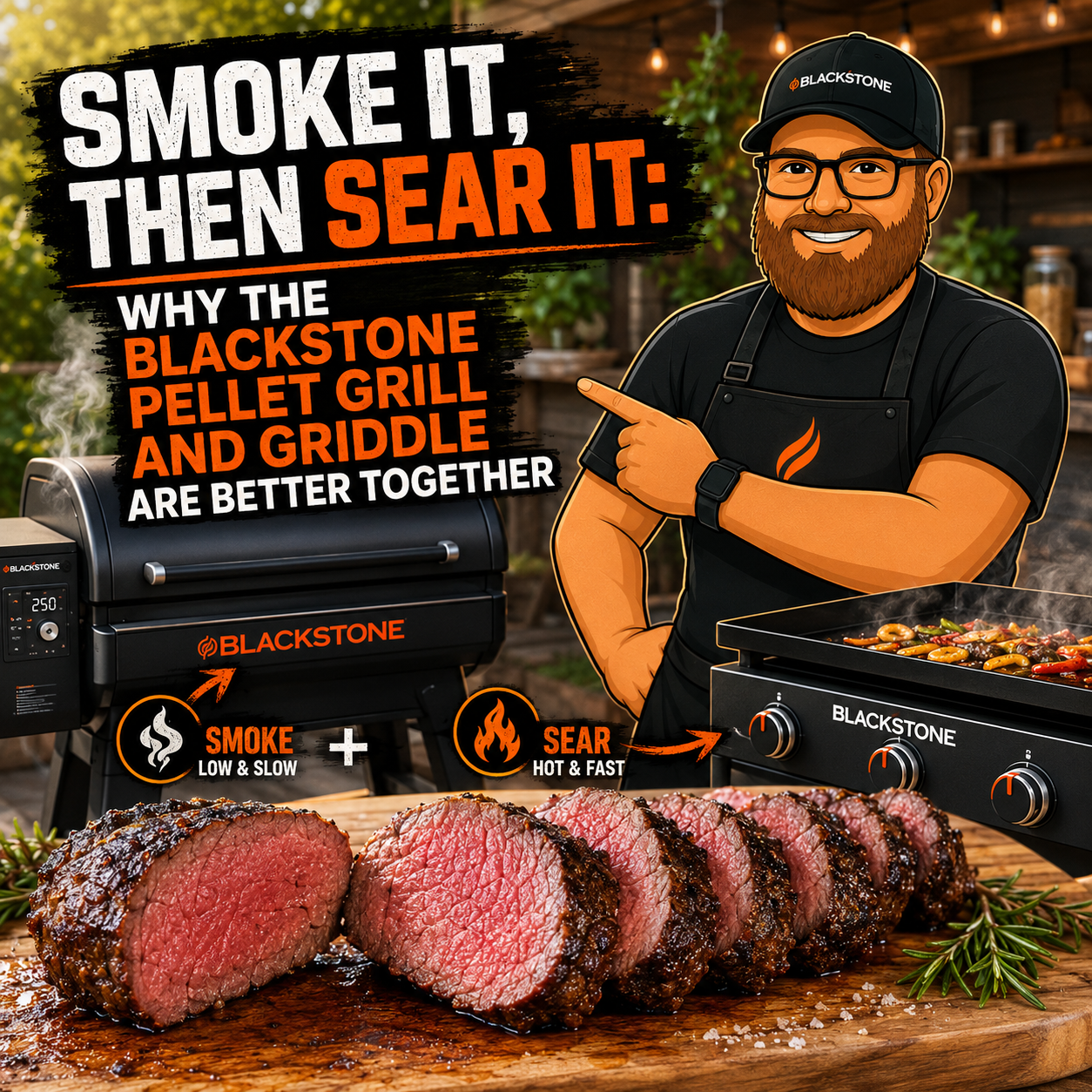

The Blackstone pellet grill and griddle each do different things extremely well. When I started using them together instead of treating them as separate cookers, it opened up a whole new way of planning meals—smoke on one, sear or finish on the other, and use the strengths of both.
For a long time, outdoor cooking equipment tended to fall into separate categories. You had a grill for grilling, a smoker for smoking, and maybe a flat-top griddle for breakfast, burgers, or hibachi. Each piece of equipment had its own job.
One of the things I have enjoyed most about expanding my Blackstone setup is realizing that I do not have to choose one cooker for an entire meal.
The Blackstone pellet grill and griddle can work together.
The pellet grill gives me steady indirect heat, smoke, and the ability to cook something low and slow. The griddle gives me direct contact with hot steel, quick browning, a hard sear, and a huge surface for finishing meat, preparing sides, toasting bread, or building the rest of the meal.
Once I started thinking about them as two parts of the same outdoor kitchen, rather than two completely separate appliances, the possibilities became much more interesting.
Each Cooker Has a Job
There are certainly meals that I cook entirely on the griddle, and there are others that can stay on the pellet grill from beginning to end. I am not suggesting that every recipe needs two pieces of equipment.
The advantage comes when a recipe benefits from two different cooking environments.
A large roast may benefit from several hours of gentle smoke but still need a better crust at the end. Pulled meat may taste great right out of the smoker, but putting some of it on a hot griddle can add crispy edges. A smoked chuck roast may become the centerpiece of a sandwich, while the griddle handles the onions, cheese, and toasted bread.
The pellet grill handles the slow part of the cook.
The griddle handles the fast part.
That division of labor gives you much more control over the final meal.
The Perfect Example: Reverse-Seared Beef Tenderloin
One of my favorite recent examples was a beef tenderloin that I reverse seared using both cookers.
I started the tenderloin on the Blackstone pellet grill and cooked it low and slow. That gave the meat time to gradually come up to temperature while picking up smoke flavor.
When it was close to the internal temperature I wanted, I moved it to a very hot Blackstone griddle.
That second step completely changed the exterior.
The hot steel created direct contact around the tenderloin and allowed me to develop a dark crust quickly without leaving the meat over high heat long enough to overcook the center.
That cook perfectly demonstrates what I mean by letting each cooker do what it does best. I was not asking the pellet grill to create a griddle-style crust, and I was not asking the griddle to slowly smoke a whole tenderloin.
The pellet grill cooked the inside.
The griddle finished the outside.
Together, they produced a result that would have been harder to achieve with either one alone.
Smoked Chuck Roast Becomes a Completely Different Meal
Another combination that has become one of our favorites starts with chuck roast.
I cook the chuck roast low and slow on the pellet grill with onions and au jus until it becomes tender enough to shred. By the time it is finished, the meat has absorbed smoke, the onions have softened, and everything has cooked together into a rich, beefy mixture.
You could stop there and have a great meal.
But then the Blackstone griddle takes it in another direction.
We use that shredded beef and au jus to build sandwiches. The rolls can be toasted directly on the griddle, the meat can be reheated or crisped slightly if needed, and cheese can melt into the sandwich while the bread develops a buttery crust.
The meal starts as barbecue and ends somewhere between a French dip, cheesesteak, and smoked-beef sandwich.
That is exactly the kind of cook that makes me appreciate having both options.
Pulled Pork Gets Even Better With a Little Griddle Time
Pulled pork is another great candidate.
After a pork shoulder spends hours on the pellet grill, it comes off tender, smoky, and ready to shred. Most of the time, you could pile it onto a bun and be completely happy.
But if I am making tacos, quesadillas, nachos, or another dish where I want more texture, I can take some of that pulled pork and put it onto a hot griddle.
The pork already has smoke flavor and tenderness from the pellet grill. The griddle adds something completely different: caramelized edges and little crispy pieces.
You can spread the meat across the steel, let it sit long enough to develop some color, then mix those crisped portions back into the softer shredded pork.
Now you have both textures in the same bite.
That is a small finishing step, but it can completely change the final dish.
Chicken Can Go From Smoked to Griddled
Chicken offers a lot of possibilities too.
You can smoke chicken breasts or thighs on the pellet grill until they are almost finished, then move them to the griddle for a quick sear or sauce finish.
You can also smoke chicken completely, chop it, and use the griddle for whatever comes next.
That could become:
- Chicken cheesesteaks
- Tacos
- Quesadillas
- Fried rice
- Loaded nachos
- Breakfast hash
- Buffalo chicken sandwiches
- Chicken Caesar wraps
The pellet grill creates the base ingredient.
The griddle transforms it into the final meal.
This is especially useful for meal prep because one batch of smoked meat can become several completely different dishes over the next few days.
Smoke First, Sauce Later
One thing I like about using both cookers is that it gives me more control over sauces.
Sugar-heavy sauces can burn when they spend too much time over high heat. On the other hand, a sauce sometimes benefits from direct heat because it thickens and caramelizes.
Using both cookers lets you separate those stages.
You can smoke the meat without covering it in sauce early in the cook. Once the meat is finished or nearly finished, move it to the griddle and add the sauce there.
Now you can watch exactly what is happening.
The sauce can bubble, reduce, and cling to the food without being exposed to hours of heat.
This works particularly well with sliced pork, chicken, sausage, and other proteins that can handle a quick griddle finish.
The Griddle Can Handle the Entire Rest of the Meal
Another advantage is that while the main protein is cooking on the pellet grill, your griddle remains available.
That means you can use it for everything else.
Imagine a smoked roast resting after several hours on the pellet grill. While it rests, the Blackstone can already be working on:
- Sautéed onions
- Peppers
- Mushrooms
- Crispy potatoes
- Asparagus
- Green beans
- Toasted bread
- Quesadillas
- Fried rice
- Breakfast sides
- Sauces
Instead of trying to fit every component around a large piece of meat inside the pellet grill, you have an entire second cooking surface available.
That becomes especially helpful when cooking for a crowd.
You Can Build Meals Backward From the Finish
Using both cookers also changes how I think about planning a meal.
Instead of starting with the appliance, I start with the result.
What do I want the food to taste like?
Does it need smoke?
Does it need a crust?
Do I want crispy edges?
Does the bread need to be toasted?
Are there vegetables or side dishes that need a completely different temperature?
Once I answer those questions, it becomes easier to decide which cooker should handle each part.
For example, if I want a tender smoked beef sandwich with caramelized onions and toasted bread, there is no reason to force the entire meal onto the pellet grill.
Let the pellet grill make the beef.
Let the griddle make the sandwich.
It Also Solves a Common Timing Problem
One of the hardest parts of cooking a large meal is timing.
Smoked meat does not always finish exactly when the recipe says it will. A roast may reach tenderness earlier than expected, or it may decide that today is the day it needs another hour.
Having the griddle gives you flexibility at the end of the cook.
If the meat finishes early, it can rest while you prepare the rest of the meal. If it needs extra time, you can delay starting the griddle components until the meat is closer to ready.
Because most griddle cooking happens relatively quickly, it becomes easier to adjust the rest of the meal around the slower pellet-grill cook.
That is a huge advantage.
Five Ways I Like to Pair the Pellet Grill and Griddle
There are countless combinations, but these are five approaches I think demonstrate the idea well.
1. Smoke, then sear
This is the reverse-sear method I used with beef tenderloin.
Cook the meat slowly on the pellet grill until it is close to the desired internal temperature, then finish it on a hot griddle.
This works well with thick steaks, tenderloin, tri-tip, and other substantial cuts of beef.
2. Smoke, then crisp
Cook pork shoulder, chicken, or another shreddable meat on the pellet grill. Once it is tender, shred it and put a portion on the griddle to create crispy edges.
This is excellent for tacos, quesadillas, nachos, and sandwiches.
3. Smoke the protein, griddle the meal
Use the pellet grill for your meat and the griddle for everything that turns that meat into dinner.
Smoked chuck roast can become sandwiches.
Smoked chicken can become fried rice.
Smoked pork can become tacos.
Smoked sausage can become breakfast hash.
4. Smoke first, glaze on the griddle
Cook the protein with smoke, then use the griddle to quickly apply and caramelize a sauce or glaze.
You get smoke flavor without forcing the sauce to survive the entire cook.
5. Use the pellet grill for the centerpiece and the griddle for the sides
This may be the simplest combination.
Smoke your main protein while preparing vegetables, potatoes, bread, or other side dishes on the griddle.
You essentially create an outdoor kitchen with two completely different cooking environments operating at the same time.
The Griddle Is Also Great for Leftovers From the Pellet Grill
Some of my favorite Blackstone meals happen the day after the original cook.
A smoked pork shoulder may have been dinner on Saturday, but Sunday morning it can become pulled-pork breakfast hash.
Leftover smoked brisket or chuck roast can become cheesesteaks.
Smoked chicken can go into fried rice.
Leftover smoked beef can be chopped and mixed into potatoes and eggs.
The griddle is particularly good at reviving leftover smoked meat because it can heat the food while creating new texture.
Instead of simply microwaving yesterday’s barbecue, you are turning it into something different.
You Do Not Need to Make the Cook Complicated
There is one caution I would give.
Just because you own multiple cookers does not mean every meal needs to use all of them.
Sometimes a smash burger should just be a smash burger.
Sometimes you want to put something on the pellet grill, close the lid, and leave it alone.
The point is not to make outdoor cooking more complicated.
The point is to recognize that you have options.
If using both the pellet grill and griddle improves the food or makes the process easier, use both.
If it does not, do not create extra work just because the equipment is sitting there.
Think of It as an Outdoor Kitchen
This is ultimately how I have started thinking about my Blackstone setup.
I do not look at the pellet grill and ask, “What pellet-grill meal should I make?”
I do not look at the griddle and ask, “What griddle meal should I make?”
I think about dinner.
Then I decide where each part of dinner belongs.
That mindset is going to become even more useful as we continue building out our Blackstone outdoor kitchen setup. The more cooking options we have available in one space, the easier it becomes to assign each part of a meal to the tool that handles it best.
The griddle does not replace the pellet grill.
The pellet grill does not replace the griddle.
They complement each other.
Final Thoughts
Some of my favorite Blackstone cooks have happened because I stopped forcing one appliance to handle the entire recipe.
The beef tenderloin was better because it could smoke slowly before hitting hot steel.
The chuck roast becomes something completely different once that smoked beef is piled onto bread toasted on the griddle.
Pulled pork gains another layer of texture when some of those tender pieces develop crispy edges on the flat top.
That is why I think the pellet grill and griddle are such a good combination.
One gives you time, smoke, and indirect heat.
The other gives you speed, direct contact, and versatility.
Smoke it on the pellet grill.
Sear it, crisp it, toast it, or finish it on the griddle.
Then bring everything together.
You do not have to choose between the two.
Sometimes the best Blackstone cook happens when you use both.
Leave a Reply