
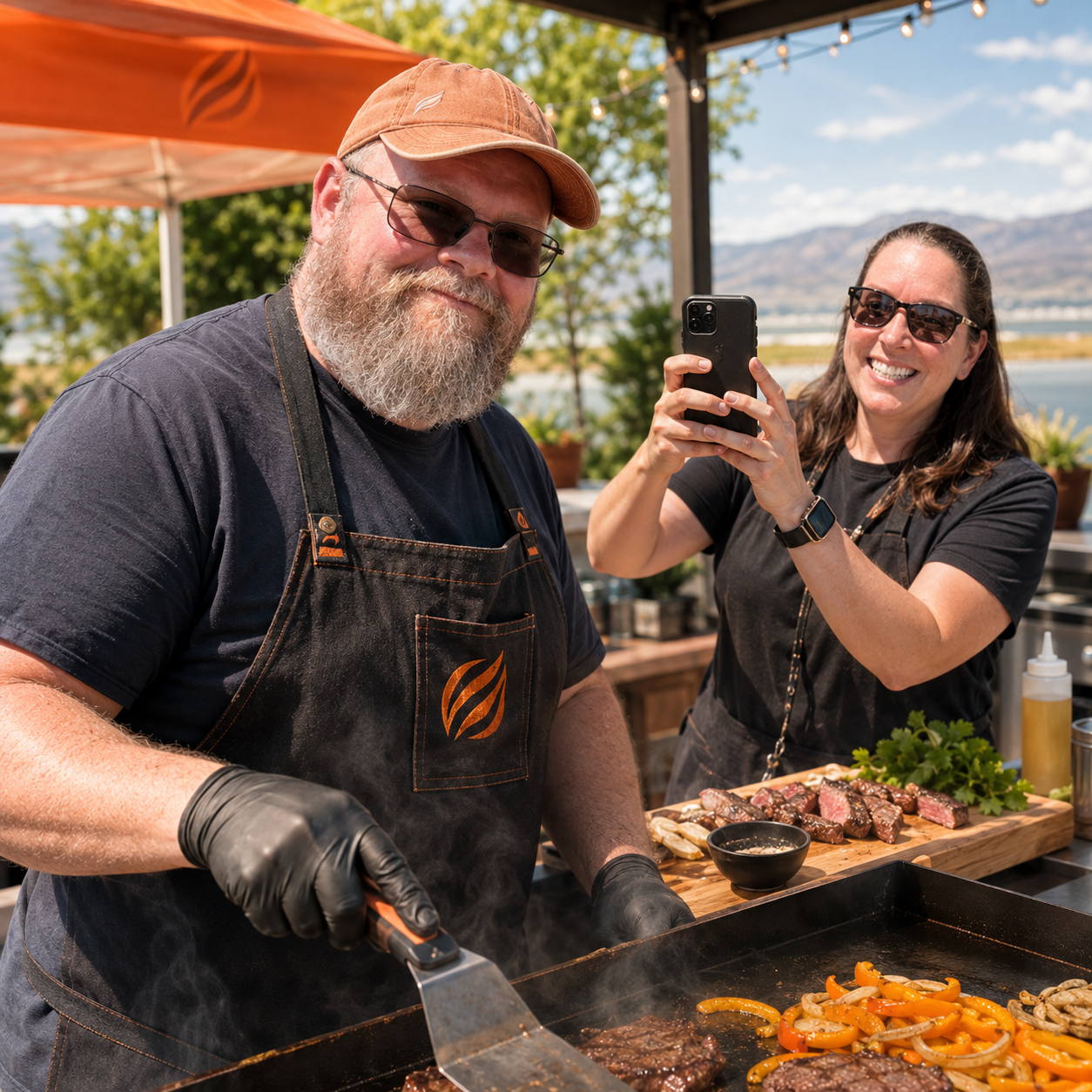

The finished recipe may only take a few minutes to watch on YouTube or Instagram, but creating that content starts long before the food hits the griddle. Behind Blackstone Cooking is a team effort that includes planning, cooking, photography, videography, editing, social media, and occasionally telling everyone they still cannot eat because we need one more picture.
When someone watches one of my Blackstone Cooking videos, the part they see is usually pretty straightforward. Ingredients go onto a griddle, pellet grill, or pizza oven, the food gets cooked, and eventually a finished dish appears on the screen.
What they do not see is everything happening just outside the camera frame.
Over the years, Blackstone Cooking has grown from me simply sharing the things I enjoy making into something that takes quite a bit of teamwork. I am still the person developing and cooking most of the recipes, editing the main videos, and managing the YouTube side of the channel, but a huge part of what people see across our other platforms comes from my wife, Justine.
She has been part of Blackstone Cooking essentially from the beginning, but her role has become increasingly important as the channel has grown. She is now our primary photographer and videographer during cooks, and she handles much of the content that appears on Facebook, Instagram, and our other social platforms.
In other words, while I may be the person standing in front of the griddle, there is usually someone standing behind the camera making sure anyone else ever gets to see it.
The Recipe Is Only the Beginning
Before we ever turn on a Blackstone, there has usually already been a fair amount of planning.
Some recipes begin because I see something and immediately start thinking about how I could make my own version of it on a Blackstone. Others come from ingredients we already have, seasonal ideas, Blackstone challenges, products we want to feature, or simply something that sounds good.
Once I settle on the idea, I start thinking about more than just whether the recipe will taste good. I also have to consider whether the process will be interesting enough to share.
What parts of the cook will people need to see? Is there a particular technique that needs a close-up? Is the finished food going to have a good visual reveal? Do we need to capture several different stages because the final YouTube video, Instagram Reel, Facebook post, and blog article may all use different pieces of the same cook?
That does not mean I develop recipes just because they will look good on camera. The food still has to work first. However, once you start creating cooking content regularly, you naturally begin thinking about both the recipe and the story of the recipe at the same time.
Justine Sees the Cook Differently Than I Do
One of the reasons having someone else behind the camera is so valuable is that I am usually focused on the food.
If I am cooking six things at once on the griddle, monitoring temperatures, explaining a technique, and trying not to burn anything, I am probably not thinking about whether the camera should move six inches to the left.
Justine is.
She is watching for the moments that I may not even realize are happening. She sees when the steam starts rolling off the food, when the cheese begins melting over the edge of a sandwich, when the spatula lifts something off the griddle at exactly the right angle, or when the finished dish needs to be rotated slightly to catch better light.
That perspective has become an important part of the way our content looks.
It also means she often sees a completely different cook than I do. I am thinking about temperature and timing. She is thinking about composition, movement, lighting, and what someone scrolling through Instagram might stop to look at.
Both perspectives matter.
The Picture That Helped Win the Great Griddleroff
Probably the best example of how important that behind-the-camera work can be came in 2023 when I entered the Great Griddleroff.
For that competition, I made a blueberry brie dessert grilled cheese. I developed and cooked the recipe, but the final image that represented the dish was photographed by Justine.
That photograph became part of the submission that ultimately helped me become the 2023 Great Griddleroff champion.
I received the award, but I have always thought there was a piece of that win that belonged to her.
In a competition where people are evaluating food they cannot actually taste, the image has to communicate what the dish is supposed to be. It needs to make someone understand the textures, flavors, and experience of eating it without ever taking a bite.
That photograph did exactly that.
It also reinforced something we had already started learning: food photography is not simply documenting what you made. It is part of telling the story of the food.
Sometimes the Food Has to Wait
There is one downside to having someone in the family who creates cooking content.
You cannot always eat when the food is ready.
There have been plenty of cooks where everyone is standing around waiting while Justine and I are moving plates, changing angles, repositioning ingredients, wiping sauce off the edge of a plate, or trying to capture one last shot.
There is almost always some version of:
“Don’t eat that yet.”
Then five minutes later:
“Okay, wait. One more picture.”
If you create food content, you know exactly what I mean.
The challenge is working quickly enough that the food still looks and tastes the way it should. Hot food begins changing almost immediately. Cheese firms up. Sauces settle. Steam disappears. Bread softens. Meat begins losing some of that fresh-off-the-griddle shine.
That is why we try to have a plan before the finished food ever reaches the cutting board.
If we know we need a sliced shot, a full plate, a close-up, and a hand-held reveal, we can move through those photographs quickly rather than figuring it out while dinner gets cold.
Capturing the Cook, Not Just the Finished Food
One thing we have become more intentional about is capturing the process.
A beautiful finished-food photograph is important, but many of the most useful pieces of content happen long before the final plate.
For a reverse-seared beef tenderloin, the final sliced meat is obviously the hero shot, but people also want to see the tenderloin on the pellet grill, the internal temperature, the transfer to the griddle, and the crust developing during the sear.
For the lobster roll hot dogs we made at the Blackstone Social Summit, the finished hot dogs looked great, but the story also included the lobster cooking in garlic butter, the Hawaiian rolls toasting on the griddle, and the competition environment around us.
Those process shots give us much more flexibility later.
A single cook may ultimately become a full YouTube video, several short vertical videos, photo posts, a blog article, and even instructional content months later.
The more pieces we capture while we are actually cooking, the more ways we can tell that story afterward.
One Cook Can Become a Lot of Content
This is probably one of the biggest lessons I have learned as the channel has grown.
You do not necessarily need to cook something different every time you want to post.
One good cook can provide content for several platforms if you capture it intentionally.
The full recipe may become the main YouTube video. A 20-second sequence showing the best parts of the cook can become an Instagram Reel or TikTok. The finished dish can become a Facebook or Instagram photo post. The process and lessons learned can become a blog article. Individual clips may later become tips, comparison videos, or instructional posts.
That approach has become even more important now that Justine handles much of our shorter-form social content.
I can focus on producing the main recipe and YouTube video, while she takes the photographs and video clips we need to keep the rest of Blackstone Cooking active.
It makes the entire process more sustainable.
The Best Content Is Not Always the Most Perfect Content
It is easy to look at cooking content online and assume everything needs to be perfect.
Perfect lighting.
Perfect camera movement.
Perfect food.
Perfect kitchen.
Perfect presentation.
I do not think that is what actually connects with most people.
Good photography and video certainly help, but viewers also want to see something they believe they can make.
Sometimes a drip of sauce, a messy cutting board, or a burger that is not perfectly symmetrical makes the food feel more real.
There is a balance.
We want our content to look good enough that people stop scrolling, but we do not want it to look so artificial that the recipe feels impossible to recreate.
The goal is not to convince someone that we cooked something perfect.
The goal is to make them think, “I want to try that.”
Behind-the-Scenes Teamwork Matters
Having Justine involved has also made it much easier for me to stay focused while I am cooking.
Trying to cook, explain, position cameras, take photographs, and capture vertical video by yourself is possible, but it is difficult to do all of those things well at the same time.
When she is filming, I can focus more on what is happening on the griddle.
When I am editing the main video, she can begin working with photographs and shorter clips for social media.
When she notices something visually interesting during the cook, she can capture it without me having to stop what I am doing.
That division of responsibilities has developed naturally over time, but it has become one of the most important parts of Blackstone Cooking.
The channel may have my face on it, but it is very much a team effort.
What We Have Learned About Food Photography
We are certainly not professional food photographers, but years of taking pictures of food have taught us a few things.
Natural light usually helps. So does getting close enough that the viewer can actually see the texture of the food. Cutting something open is often more interesting than simply photographing it whole. A sandwich becomes much more appealing when you can see the layers inside. A steak becomes much more compelling when someone can see the doneness and crust.
We also learned that the cooking environment can add to the photograph rather than distract from it.
Sometimes leaving a Blackstone spatula, part of the griddle, a cutting board, or even the pellet grill slightly visible in the background tells the viewer where the food came from.
It makes the picture part of the Blackstone Cooking story instead of simply another food photograph.
The goal is usually not to make the scene look untouched.
The goal is to make it look like you arrived at exactly the right moment.
Short-Form Video Changed the Way We Film
When we first started creating content, the main focus was naturally YouTube.
That meant filming horizontally and thinking primarily about a longer recipe video.
Short-form content changed that.
Now we also have to think vertically.
A shot that looks fantastic on YouTube may not work at all in a Reel because the subject gets cropped out. That means Justine often captures the same moment in different orientations or moves closer so we have usable footage for multiple platforms.
It has changed how we think about filming a cook.
Instead of asking, “Did we get the shot?” the question is sometimes, “Did we get the shot for YouTube, and did we get the vertical version too?”
It adds another step, but it also allows one recipe to reach completely different audiences.
Editing Is Where the Story Finally Comes Together
After the cooking ends and the food finally gets eaten, there is still a lot of work left.
For the main Blackstone Cooking videos, I go through the footage and decide what actually needs to stay.
Most cooks contain more footage than anyone needs to watch.
The editing process is about finding the story.
What does the viewer need to understand?
Where can I remove something repetitive?
Which close-up makes the technique clearer?
Where should the finished-food reveal happen?
The same cook may look completely different once Justine begins creating a short Reel from it. A ten- or fifteen-minute YouTube recipe might become a 20-second burst of sizzling food, quick cuts, and a finished reveal.
Neither version is necessarily better.
They simply have different jobs.
The Person Behind the Camera Deserves Credit Too
One of the reasons I wanted to write this article is because cooking creators often become the visible face of a much larger process.
People see the person holding the spatula.
They do not necessarily see the person holding the camera.
For Blackstone Cooking, that person is very often Justine.
Many of the photographs people have reacted to, shared, or commented on came from her camera. Many of the short videos that appear across our social channels start with footage she captured while I was concentrating on the food.
Her work has become part of the visual identity of the channel.
The Great Griddleroff photograph may be the easiest example to point to, but there are hundreds of others.
And now that she is taking an even larger role in our social media presence, that contribution is only becoming more important.
Advice for Anyone Creating Their Own Cooking Content
If you are thinking about sharing your own Blackstone cooks online, my biggest recommendation is not to wait until you have professional equipment or a complicated production setup.
Start with what you have.
Pay attention to lighting.
Get closer to the food.
Capture the moment when something changes—the smash, the flip, the cheese melt, the slice, the steam, the sauce pour.
Take photographs before everyone eats.
And if you are lucky enough to have someone willing to stand behind a camera while you cook, appreciate them.
Preferably before they remind you how many meals they have eaten cold because you needed “just one more shot.”
Final Thoughts
Blackstone Cooking started because I enjoyed cooking and wanted to share what I was making.
That part has never changed.
What has changed is everything that happens around the cook.
Today, creating one recipe can involve planning, cooking, photography, horizontal video, vertical video, editing, social posts, Reels, YouTube, and eventually a blog entry like this one.
It is a lot more involved than simply putting food on a griddle.
But it is also a lot of fun.
And it has become something Justine and I genuinely create together.
I may still be the guy standing in front of the Blackstone with the spatula, but there is an entire side of Blackstone Cooking happening behind that camera.
And more often than not, that is where the picture everyone remembers actually comes from.
Leave a Reply