
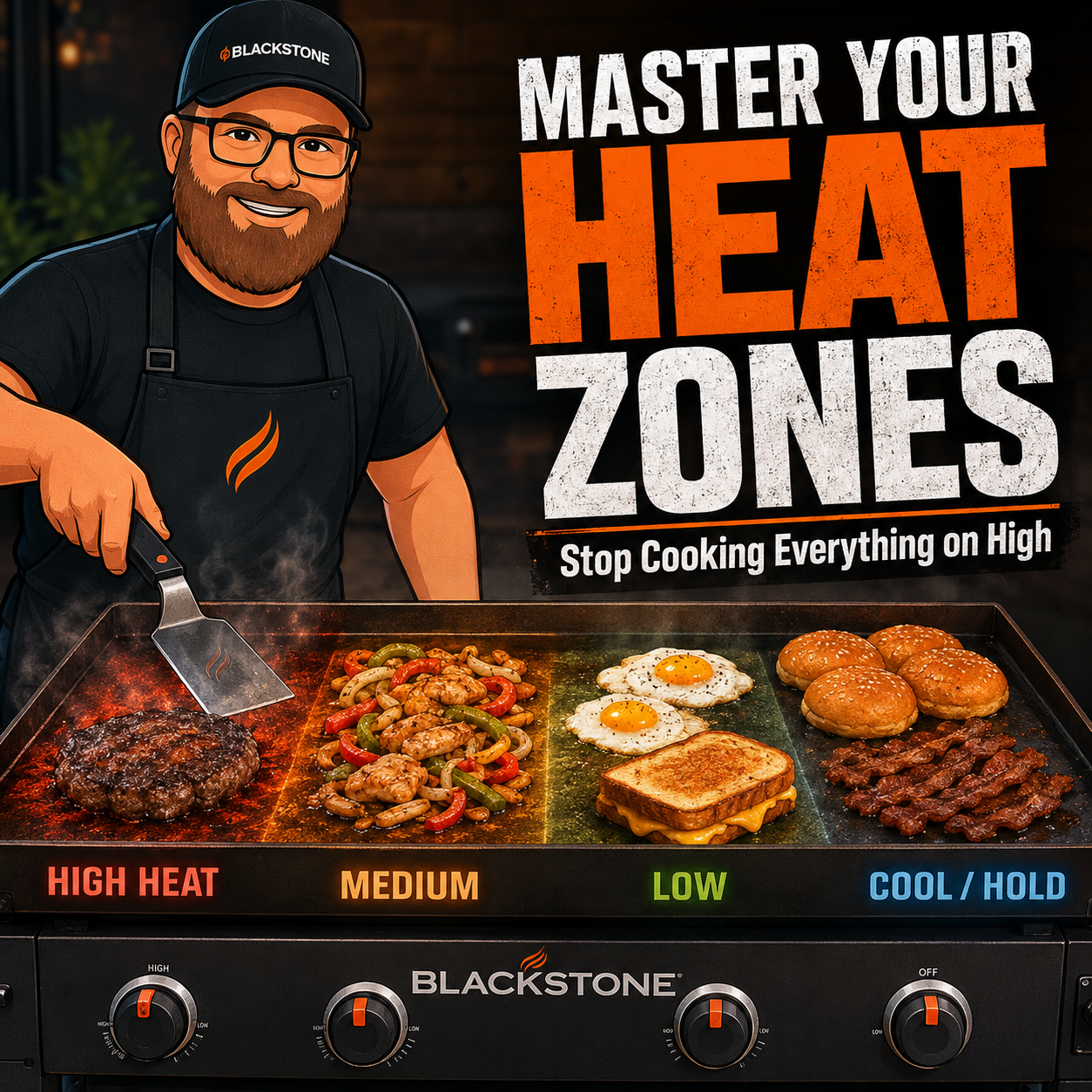

One of the biggest upgrades you can make as a Blackstone cook has nothing to do with buying another accessory. It is learning how to use different heat zones across the griddle instead of treating the entire surface like one giant burner.
When people first get a Blackstone, one of the most common instincts is pretty simple:
Turn every burner on.
Turn them all up.
Start cooking.
And to be fair, that works for some things.
If you are making smash burgers, searing steak, or trying to get a quick crust on something, high heat can absolutely be your friend.
But one of the things I have learned over the years is that a Blackstone becomes much more useful when you stop thinking of it as one giant flat cooking surface and start thinking of it as several different cooking zones.
That is where the flexibility really starts to show.
A well-managed griddle might have one area running hot, one at medium heat, one at low heat, and one section that is almost completely off.
Once you understand how to use those zones, cooking multiple foods at the same time becomes much easier.
And just as importantly, your food starts turning out better.
What Is a Heat Zone?
A heat zone is simply an area of the griddle that is running at a different temperature than the rest of the surface.
On a multi-burner Blackstone, you can create those zones by adjusting the burners independently.
For example:
- One burner may be on high.
- Another may be on medium.
- Another may be on low.
- Another may be completely off.
That gives you four very different cooking environments on the same piece of steel.
Instead of constantly pulling food off the griddle because it is cooking too fast, you can simply move it.
That is one of the biggest advantages of flat-top cooking.
Why Heat Zones Matter
Different foods need different temperatures.
That sounds obvious, but it is easy to forget when everything is sitting on the same griddle.
A smash burger wants intense heat.
Eggs do not.
Vegetables may need enough heat to brown but not so much that they scorch before softening.
Bread needs enough heat to toast without burning.
Finished meat may need somewhere warm to sit while the rest of the meal catches up.
If every burner is set the same way, you lose that flexibility.
With heat zones, the griddle becomes a much more controlled cooking environment.
You can sear, sauté, toast, hold, and finish—all at the same time.
The Four-Zone Setup I Like to Think About
You do not always need four zones, but this is a useful way to visualize the griddle.
Zone 1: High Heat
This is your searing zone.
Use it for things like:
- Smash burgers
- Steaks
- Bacon that needs crisping
- Sausage
- Getting color on vegetables
- Finishing a reverse-seared piece of meat
- Creating a crust on sandwiches
This is where you want aggressive heat and direct contact.
The key is not leaving delicate food there too long.
High heat should be intentional.
Zone 2: Medium Heat
This is probably the most useful zone on the entire griddle.
Use medium heat for:
- Hibachi
- Chicken
- Vegetables
- Fried rice
- Cheesesteaks
- Quesadillas
- Grilled sandwiches
- Pancakes
- Tortillas
This zone gives you enough heat to brown food while still giving you time to manage it.
A lot of cooks that start on high can move here once the initial sear is done.
Zone 3: Low Heat
This is where you slow things down.
Use it for:
- Eggs
- Delicate seafood
- Melting cheese
- Warming tortillas
- Toasting bread gently
- Holding vegetables
- Finishing foods without burning them
This area becomes especially useful when you are cooking for several people.
Something may be technically finished before the rest of the meal is ready.
Low heat gives it somewhere to go.
Zone 4: The Cool or Off Zone
This may be the most underrated part of the griddle.
Sometimes the best burner setting is off.
An off burner still receives some residual heat from the rest of the griddle, but the area is dramatically cooler.
Use it for:
- Holding finished food
- Resting meat
- Staging ingredients
- Temporarily moving something out of danger
- Keeping bread warm
- Preventing food from overcooking while you finish another component
This becomes your safety zone.
If something is browning too quickly, you do not have to panic.
Move it.
Your Blackstone Is Not the Same Temperature Everywhere
Even if every burner is turned to the same setting, the griddle surface will not necessarily be perfectly uniform.
Wind, outside temperature, the position of the burners, food already on the surface, and even where grease or moisture is sitting can affect how the griddle behaves.
That is why I pay attention to what the food is actually doing rather than assuming the entire surface is identical.
If onions are barely sizzling in one spot and aggressively browning three inches away, the griddle is telling you something.
Listen to it.
A Great Example: Hibachi
Hibachi is one of the best examples of why heat zones matter.
You might be cooking:
- Chicken
- Steak
- Shrimp
- Fried rice
- Vegetables
- Eggs
All on the same griddle.
Those foods do not need the same amount of heat or the same amount of time.
You can use a hotter area for the meat.
A medium area can handle the vegetables.
Rice can cook and crisp in another section.
Eggs can go onto a slightly cooler portion so they do not immediately overcook.
Finished meat can move to the low or off zone while everything else comes together.
Without heat zones, hibachi can turn into a race.
With them, it becomes much easier to control.
Smash Burgers Are Another Good Example
Smash burgers need high heat at the beginning.
You want the meat to make hard contact with the steel and develop that crust quickly.
But once the burgers are flipped and the cheese goes on, you do not necessarily need the same level of heat.
You can move the patties to a medium zone while the cheese melts.
At the same time, the buns can toast on another section.
Finished burgers can move to a cooler section while you assemble everything.
One griddle.
Several jobs.
That is the point.
Breakfast Is Where Many People Learn This Lesson the Hard Way
Breakfast can be one of the most unforgiving Blackstone cooks.
Bacon likes a certain amount of heat.
Pancakes need something different.
Eggs are even more delicate.
Hash browns may need a lot of heat and plenty of time.
If everything is cooking at full blast, you can go from breakfast to disaster quickly.
I like having:
- A hotter section for hash browns and bacon
- A medium section for pancakes
- A lower-temperature section for eggs
- A cool zone for holding finished food
This setup allows you to cook an entire breakfast without every item demanding attention at the same moment.
Grilled Sandwiches Need More Control Than People Think
One of the easiest foods to burn on a Blackstone is a grilled sandwich.
The outside can look perfect before the cheese inside has completely melted.
That is especially true with thick sandwiches.
A good method is to start the sandwich over medium heat to develop color, then move it to a lower-temperature section.
That gives the cheese time to melt without turning the bread black.
You can also use a dome over the sandwich for a short period to trap heat and help the interior warm through.
The same idea works for quesadillas, melts, and stuffed sandwiches.
Heat Zones Help With Timing
Cooking multiple things at once is not really about getting everything done quickly.
It is about getting everything done at the same time.
That distinction matters.
If your burgers finish ten minutes before the onions, the meal is not really finished.
If your eggs are done while the bacon is still raw, you have a timing problem.
Heat zones give you control over that timing.
You can speed one food up.
Slow another down.
Hold something temporarily.
Move something out of the way.
Then bring everything together when it is actually time to eat.
Start With the Food That Takes the Longest
When cooking a meal with several components, I usually think backward from the finish.
What takes the longest?
That goes first.
For example, if I am making cheesesteaks:
- Start the onions and peppers.
- Let them soften and develop color.
- Move them to a lower-temperature zone.
- Cook the meat over higher heat.
- Combine everything.
- Add cheese.
- Toast the rolls.
- Assemble.
The vegetables are not sitting on high heat the entire time.
They move.
The meat gets the hotter section when it needs it.
The rolls get their own space.
That is heat-zone cooking.
Use the Whole Surface
One mistake people make is crowding everything into the middle of the griddle.
You paid for all that steel.
Use it.
Spread ingredients out.
Give food room to brown.
Move finished items away from active cooking areas.
Use the edges.
Use the back.
Use the cooler corners.
The more comfortable you become moving food around the surface, the easier large cooks become.
Do Not Be Afraid to Turn a Burner Off
This is worth repeating.
You do not have to keep every burner running.
If you are cooking something that is getting ahead of the rest of the meal, turn a burner down or shut it off completely.
The griddle retains heat.
That area will not instantly become cold.
Instead, it becomes a useful holding zone.
Sometimes I intentionally leave one burner off from the beginning because I know I will need that space later.
Wind Can Change Everything
Outdoor cooking means the environment matters.
Wind can pull heat away from certain parts of the griddle.
It can also affect how efficiently the burners operate.
If the wind is strong, you may notice one side of the griddle behaving differently than the other.
Do not blindly trust the burner settings.
Watch the food.
If one zone needs more heat, adjust it.
If another is running hotter than expected, turn it down.
Cooking outside always requires a little flexibility.
A Thermometer Can Help
An infrared thermometer can be useful for learning how your griddle behaves.
You can point it at different areas of the cooking surface and see just how much temperatures vary.
That can be especially helpful when you are first learning a new griddle.
Over time, you begin to recognize the signs.
The sound of the sizzle.
How quickly butter melts.
How oil behaves.
How fast a tortilla begins to brown.
Eventually, you develop a feel for the surface.
But a thermometer can help you get there faster.
Heat Zones Are Especially Important When Cooking for a Crowd
When you are cooking for two people, you can sometimes get away with treating the whole griddle the same.
When you are cooking for ten, twenty, or more?
Heat zones become almost essential.
You need somewhere for finished food.
You need somewhere to keep cooking.
You need somewhere to toast.
You need somewhere to stage.
You may have multiple proteins going at once.
The griddle becomes less like one pan and more like a small kitchen line.
That is when heat management really starts to matter.
Common Heat-Zone Mistakes
Turning everything to high
This is probably the biggest one.
High heat has a purpose, but not every food needs it.
Never moving food
If something is cooking too fast, move it.
The entire point of having a large flat surface is that you have options.
Letting finished food sit over direct heat
Once something is done, get it away from the active cooking zone.
Do not let perfectly cooked food become overcooked while you finish something else.
Starting every ingredient at the same time
Different foods take different amounts of time.
Plan the order before everything hits the griddle.
Crowding the hot zone
Too much food in one area can drop the surface temperature and prevent proper browning.
Give food room.
Ignoring carryover heat
A burner being turned off does not mean that section instantly becomes cold.
The steel holds heat.
Use that to your advantage.
Think of the Griddle as a Kitchen, Not a Pan
This is probably the biggest mindset shift.
A frying pan has one basic temperature.
A Blackstone can have several.
That means the person cooking needs to think more like someone working a restaurant flat top.
You are managing space.
You are managing heat.
You are managing timing.
You are deciding where each ingredient belongs at each stage of the cook.
Once you start thinking that way, complicated meals become much less intimidating.
Final Thoughts
Learning to manage heat zones is one of the simplest things you can do to become a better Blackstone cook.
It does not require a new accessory.
It does not require an expensive thermometer.
It does not require a complicated technique.
It just requires you to stop treating the entire griddle like it has one job.
Turn one section up.
Turn another down.
Leave a section cool.
Move food as it cooks.
Give different ingredients the temperature they actually need.
Once you start doing that, you will probably wonder why you ever cooked with every burner set exactly the same.
A Blackstone is not just one big cooking surface.
Used correctly, it can be several cooking stations all at once.
And that is when the griddle really starts to shine.
Leave a Reply